
Tena Bar - Seven Gates to Pass
Auditing the Only Physical Evidence Ever Found Outside Flight 305
On February 10, 1980, eight-year-old Brian Ingram scraped a shallow campfire pit at Tena Bar (Columbia River Mile 96.9) and uncovered three edge-rotted stacks of twenty-dollar bills from D.B. Cooper's 1971 ransom. For any explanation of how that money got there to make sense, it must pass seven unforgiving physical, forensic, and behavioral gates.
Seven Hurdles Every Tena Bar Theory Must Pass
On Sunday afternoon, February 10, 1980, eight-year-old Brian Ingram and his five-year-old cousin Denise (43 / 203–205 / 17411–17413 [press]; 9 / 208–209 / 912, 918 [press]) knelt in damp Columbia River sand at a private Clark County beach spelled variously Tena Bar and Tina Bar (45.717888°N, −122.759500°W, Columbia River Mile 96.9, Citizen Sleuths — Tena Bar Money Find). Scraping shallow sand for a hot-dog campfire roughly twenty yards up from the winter waterline (43 / 218 / 17427 [press]), Brian uncovered three wet, edge-rotted clumps of twenty-dollar bills still encircled by crumbling rubber bands (96 / 302–307 / 43236–43241).
If you only know Tena Bar from television documentaries, you have heard the sanitized bedtime version. The actual FBI file is far funnier and far messier. The Ingrams carried the sodden mass home and brought it into the Portland FBI office two days later inside "a small plastic sandwich baggie" (96 / 339 / 43274). Within forty-eight hours, a female relative brought agents four intact souvenir $20 bills (logged in a 1986 Lab report as Q60–Q63, 43 / 422 / 17671) that had quietly been held back before the Bureau was called, and the family took pains in their FD-302s (FBI witness interview reports) to stress that Brian's father, Harold Dwayne Ingram [inference] (9 / 199 / 903), "WAS MANY FEET AWAY FROM THE FIRE AND THE PLACE WHERE THE MONEY WAS FOUND AND WAS ACTUALLY NEAR THE WATER'S EDGE" when the kids hit paydirt (96 / 305, 336–338 / 43239, 43271–43273). That distance did not save Harold Dwayne Ingram from the perils of sudden fame: after a wire photo of him digging ran nationwide, police recognized and arrested him on an Oklahoma warrant over a car he had financed through GMAC (63 / 99 / 26465 [press]; 44 / 18 / 17710).
Fifty-five years after Northwest Orient Flight 305 and forty-six years after Brian Ingram's campfire, specimen Q58 (the FBI Laboratory's main Tena Bar cash batch—"Approximately 290 twenty dollar bills ($5,800.00)", 43 / 281 / 17504) plus those four souvenir twenties remain the only confirmed physical evidence ever recovered outside the Boeing 727. Every camp in the Cooper Vortex claims Tena Bar proves its pet theory—usually because each theory only checks one clue in isolation. Every FBI statement below carries its image-verified Part / PDF page / Bates citation; every deduction is labeled [inference].
Executive Summary: What It Means to Pass All Seven Gates
Think of the Seven Gates not as trivia topics, but as seven real-world checkpoints that any explanation for how the money reached Tena Bar—natural washdown, mechanical dredge, or human hands—must pass in order to make sense. If a theory fails even one gate, that delivery path breaks:
- Gate 1 (Upstream River Flow & Tides): Can water physically carry cash to River Mile 96.9? Every 8:11–8:16 PM Clark County creek empties 9.4 to 9.9 miles downstream of Tena Bar, and Pacific flood-tide reversals die 7.3 miles short (Kukulka 2002; 43 / 378 / 17614).
- Gate 2 (Flight Clock & Corridor Geometry): How does the cash get from Flight 305 onto an upstream path? Even a shifted western track stays downstream until ~8:16:30+ PM—leaving a late dry floodplain landing (8:16:45–8:17:45 PM) swept in by the June 1972 surge as the lone natural-arrival loophole (Oscillations).
- Gate 3 (Three-Bundle Cohesion & Cabin Packaging): How did three $2,000 packets (~$5,800) separate from the heavy canvas bank bag and the other 97 packets ($194,000), yet arrive side-by-side in one spot inside rubber bands? Testing cabin tip offers (110 / 29, 44 / 319, 334), Sea-First's $250,000 reserve (10 / 459–460 / 1692–1693), Part 97's 318 serial lines, and the unread 16mm photo reel (21 / 8–11 / 6231–6234) shows why selective three-pack arrival strains pure river luck.
- Gate 4 (Spring Diatoms, Zero Clay & Sand Pores): How did May–June Asterionella colonies (Kaye & Meltzer 2020) enter the bills with zero winter clay or silt (43 / 426–427 / 17675–17676)? Together they point to springtime wetting, while 100–160 μm star colonies make percolation through packed sand unlikely [inference].
- Gate 5 (Stationary Stack Decay & Brittle Rubber): How did the bills form rounded oval corners around crisp centers while brittle rubber bands stayed whole until touched (96 / 304 / 43238)? The FBI Lab's exam of the buried, wet 1950 Brink's loot (FBI History), plus the Andrea Doria and BEP cases, shows that stationary rot in damp ground rounds and fuses stacks without riverbed tumbling.
- Gate 6 (Buoyancy, Ice Rafts, Dredge & Beach Burial): Soaked bills (~1.22 g/cm³) and a wet canvas bag sink within minutes (Citizen Sleuths), melting January 1979 river ice (Weatherwise 1979) leaves debris on top of the beach rather than 3–8 inches deep, cutterhead physics kills the 1974 dredge, and 2009 erosion disproved Dr. Leonard Palmer's 1974 clay-floor lock (Palmer Report).
- Gate 7 (Sort of a Gate — "Did a Human Bury It?"): Unlike Gates 1–6, human motive is not a physical barrier—the only reason this comes up is because every physical gate seems to require a human burying the cash on Tena Bar. Yet every motive—the 1976 John Doe indictment, a Tina = Tena homage, or a cryptic treasure stash—defies practical sense, setting up our closing Occam's Razor verdict.
Gate 1: Upstream River Flow & Tides (Why Clark County Drains the Wrong Way)
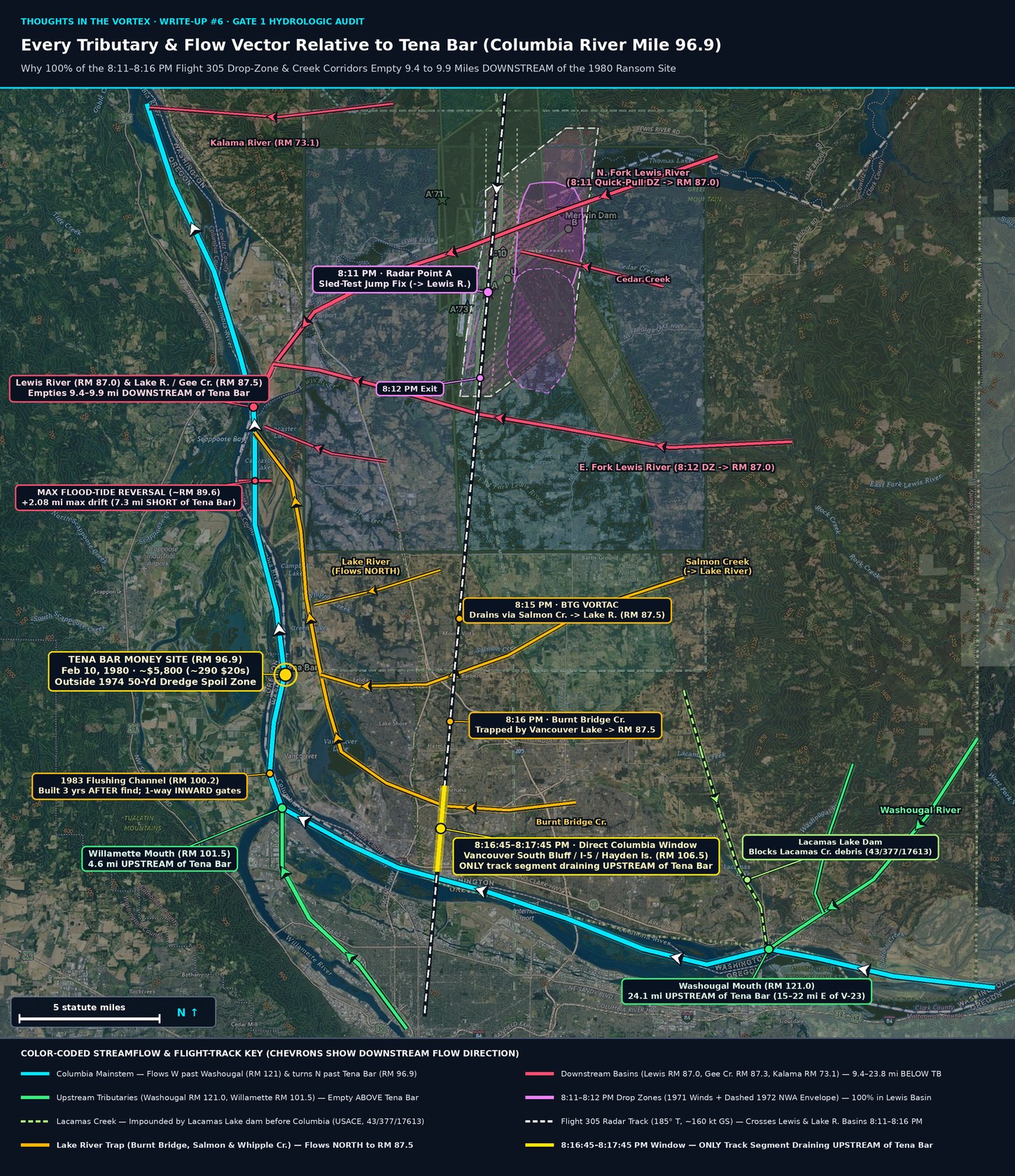
To clear Gate 1, any waterborne explanation must move money downstream with the river to Tena Bar. Tena Bar (45.717888°N, −122.759500°W, Citizen Sleuths) sits on the Washington outer bend of the Lower Columbia at River Mile (RM) 96.9, where the river has already turned ninety degrees north past Portland and Kelley Point (RM 101.5) toward Longview and the Pacific (USACE Portland-Vancouver Harbor Info). Along this reach, north is downstream—creating one of the nastiest geographic illusions in true crime.
| Waterway / Landmark | Columbia RM | Distance vs. Tena Bar | Drains Which Zone? | Water Path to Tena Bar? |
|---|---|---|---|---|
| Washougal River Mouth | RM 121.0 | 24.1 mi UPSTREAM | Skamania / E. Clark (15–22 mi E) | Yes hydrologically (43/377/17613); off track |
| Lacamas Creek (Camas) | ~RM 120.8 | 23.9 mi UPSTREAM | Upper Camas / Hockinson basin | Upper basin dammed (43/377/17613) |
| I-5 Bridge / Hayden Is. | RM 105–106.5 | 8.1–9.6 mi UPSTREAM | ~8:17 PM late-jump crossing | Yes — direct mainstem upstream |
| Willamette River Mouth | RM 101.5 | 4.6 mi UPSTREAM | Portland / Columbia Slough | Yes — enters at Kelley Point |
| 1983 Flushing Channel | ~RM 100.2 | 3.3 mi UPSTREAM | Artificial Vancouver Lake cut | No — dug in 1983; 1-way inward (POV) |
| TENA BAR MONEY SITE | RM 96.9 | 0.0 mi (Target) | Egger beach / Fazio gate (43/212/17420) | Discovery site (Feb 10, 1980) |
| Lake River Mouth | RM 87.5 | 9.4 mi DOWNSTREAM | Burnt Bridge, Vancouver Lk., Salmon & Whipple Cr. | No — 9.4 mi below Tena Bar (Clark Co.) |
| Gee Creek Mouth | ~RM 87.3 | 9.6 mi DOWNSTREAM | Ridgefield upland | No — 9.6 mi below Tena Bar |
| Lewis River Mouth | RM 87.0 | 9.9 mi DOWNSTREAM | All 8:11–8:12 PM Drop Zones | No — "is not possible" (43/378/17614) |
| Kalama River Mouth | RM 73.1 | 23.8 mi DOWNSTREAM | Northern search perimeter | No — 23.8 mi below Tena Bar |
The Lake River Hydrodynamic Trap
Glance at a street map of Vancouver and you see Salmon Creek (~45.71°N) and Burnt Bridge Creek (~45.65°N) flowing west toward the Columbia directly across from Tena Bar (45.718°N). Follow the amber lines on Figure 1 and see what actually happens: Burnt Bridge Creek empties into shallow Vancouver Lake (WA Ecology Pub. 80-11-004), walled off from the Columbia by diked lowlands. Water exits north into sluggish Lake River (Lake River), captures Salmon Creek (just 1.3 miles inland behind Tena Bar) and Whipple Creek (Clark County Watershed Report), and runs eleven miles due north to enter the Columbia at Ridgefield (RM 87.5)—9.4 river miles downstream of Tena Bar. Nor could debris shortcut through the Port of Vancouver's Flushing Channel at RM 100.2: that cut opened in 1983 (three years after Brian's find) with one-way culverts letting Columbia water in, never lake water out (Port of Vancouver Fact Sheet). Upstream near Camas, the Lacamas Lake dam traps the upper Lacamas Creek headwaters while leaving the steeper Washougal River (RM 121.0) free-flowing—where the Corps hydrologist noted the December 2, 1977 flood was the logical wash-down window if cash had ever entered that far east (43 / 377 / 17613).
Why the "Tidal Reversal" Theory Is Effectively Ruled Out
Because every Clark County drop-zone creek enters the Columbia nearly ten miles downstream of Tena Bar, supporters of a drop-zone washdown periodically propose an unfamiliar mechanism to bridge the gap: Pacific tidal reversal. Many readers do not realize ocean tides reach Portland and Vancouver at all. Because no dam sits between Bonneville Dam (RM 146.1) and the Pacific Ocean at Astoria, incoming ocean high tides push a long pressure wave almost 150 miles inland (USGS Gauge 14144700). When the Columbia is running low in late summer or autumn, that incoming tide does not merely raise the water level—for two to four hours, it can stall and briefly push the river's current backward (upstream). Periodically, someone suggests that this reverse tidal flow carried Cooper's bundles 9.4 to 9.9 miles upriver from the Lewis River or Lake River mouth onto Tena Bar.
On February 20, 1980, an Army Corps of Engineers hydrologist ([inference: George Holmes], 43 / 377–378 / 17613–17614) told the FBI flatly that upstream movement from the Lewis River to Tena Bar "is not possible." Measured Lower Columbia river physics shows why tidal delivery to Tena Bar is effectively impossible:
- Zero reverse flow during major winter floods or high spring surges: Tobias Kukulka's tidal-fluvial modeling of the Lower Columbia (Kukulka 2002 OHSU Thesis) demonstrates that whenever river flow exceeds ~251,000 cfs (cubic feet per second—a level reached by most May–June snowmelt freshets [spring flood surges] and major winter floods), downstream river volume completely overpowers the ocean tide. Reverse flow vanishes everywhere above RM 53.8—more than forty-three miles downstream of Tena Bar.
- At low water, a 2-mile nudge upstream is wiped out by a 5-to-10-mile flush toward the ocean: Even during extreme autumn low water (~90,000–120,000 cfs) with a strong tide reversing current at −0.5 to −1.2 ft/s for 3 to 4 hours, integrating the half-sine tide (dmax = 2 × Vpeak × T / π) gives a maximum single-tide upstream drift of only 0.65 to 2.08 statute miles—moving an object from RM 87.5 to at most RM 89.6, still 7.3 miles short of Tena Bar. Immediately afterward, 8 to 9 hours of much stronger outgoing ebb flow (+1.5 to +2.5 ft/s) sweeps that object 5 to 10 miles downstream toward the Pacific (USGS SIR 2018-5161; Kukulka 2002). Every daily tide cycle ratchets sunken or suspended cash (which loses buoyancy within minutes; see Gate 6A) farther out to sea, never 9.4 miles upriver.
Gate 2: Flight Clock & the 8:16–8:17:45 PM Dry-Landing Loophole
In Write-Up #5 (We're Getting Some Oscillations in My Sanity), we rebuilt Flight 305's trajectory from McChord Air Force radar, Northwest's Minneapolis time-standard radio tape (41 / 30–32 / 11398–11400), the January 6, 1972 Hoquiam sled test (18 / 317 / 5650 [stamp illegible; number inferred]; 41 / 36 / 11404), and November 24–25, 1971 weather-balloon winds (~231° true at 33 kt at 10,000 ft easing to 250°/10 kt near the ground). At 8:11 PM (0411Z ±1 min), the 727 was at Point A (45.9152°N, −122.60988°W) near Highland (110 / 267–269 / 566–568), flying 185° true at ~160 knots ground speed (3.07 statute miles/min) past the Battle Ground VORTAC (radio navigation beacon) toward the 8:20–8:22 PM fix "23 DME S PDX"—23 nautical miles (DME, distance-measuring equipment) south of Portland Airport (110 / 119, 141 / 411, 438; 64 / 306 / 27172). Every 8:11–8:12 PM drop zone drains into the Lewis River (9.9 miles downstream of Tena Bar) and sits 15 to 22 miles west of the Washougal headwaters.
Why "Western Flight Path" Variants Still Miss Tena Bar at 8:11–8:15 PM
Advocates of a "Western Flight Path" argue that radar plotted Flight 305 three to five miles too far east, putting the true path over Woodland, Ridgefield, or the Columbia mainstem. Check the river's ninety-degree northward turn on Figure 1: from Kelley Point (RM 101.5) past Tena Bar (RM 96.9) to Kalama (RM 73.1), the Columbia runs due north along 122.75°W–122.79°W. Sliding the southbound track 3 to 5 miles west at 8:11–8:15 PM merely crosses the Columbia between Woodland (RM 84) and Caterpillar Island (RM 87–95)—still 2 to 13 miles downstream of Tena Bar. On either corridor, Flight 305 does not cross water draining upstream of RM 96.9 until roughly 8:16:30 to 8:17:45 PM [inference].
Testing a Late Dry Landing (8:16–8:17:45 PM) Swept In by Later Flooding
What if the 8:11 PM bump was merely Cooper stepping onto the aft airstairs (11 / 260 / 2187), and he jumped five to six and a half minutes later during Northwest's 8:12–8:20 PM company-radio gap (110 / 108 / 400; 64 / 306 / 27172), landing dry in the wild until a later flood swept the cash into the river? (Near Portland Airport, shallow Columbia Gorge east winds below 1,000 ft often shear westward against upper southwest winds, pulling final canopy drift slightly toward Hayden and Pearcy Islands [inference].)
| Exit Window | 727 Position (185° T) | Dry Landing Zone | Flood Waterway | Gate 1 & 4 Result |
|---|---|---|---|---|
| 8:15:00 PM | ~45.738°N, −122.633°W (S. of BTG) | Pleasant Valley / Salmon Cr. | Salmon Cr. → Lake R. | FAILS Gate 1 (9.4 mi below) |
| 8:16:00 PM | ~45.694°N, −122.640°W (Hazel Dell) | Hazel Dell / Orchards | Burnt Bridge → Lake R. | FAILS Gate 1 (Vancouver Lk.) |
| 8:16:45–8:17:15 | ~45.660°N–45.638°N (Vancouver) | Central Vancouver; bank only via drift [inference] | Columbia (RM 106–108) | CLEARS Gate 1 (<22 ft elev.) |
| 8:17:15–8:17:45 | ~45.638°N–45.615°N (I-5 / Hayden Is.) | Hayden / Pearcy Is. / N. Portland benches (10–22 ft) | Columbia (RM 105–107) or Willamette | BEST NATURAL FIT (June '72 flood) |
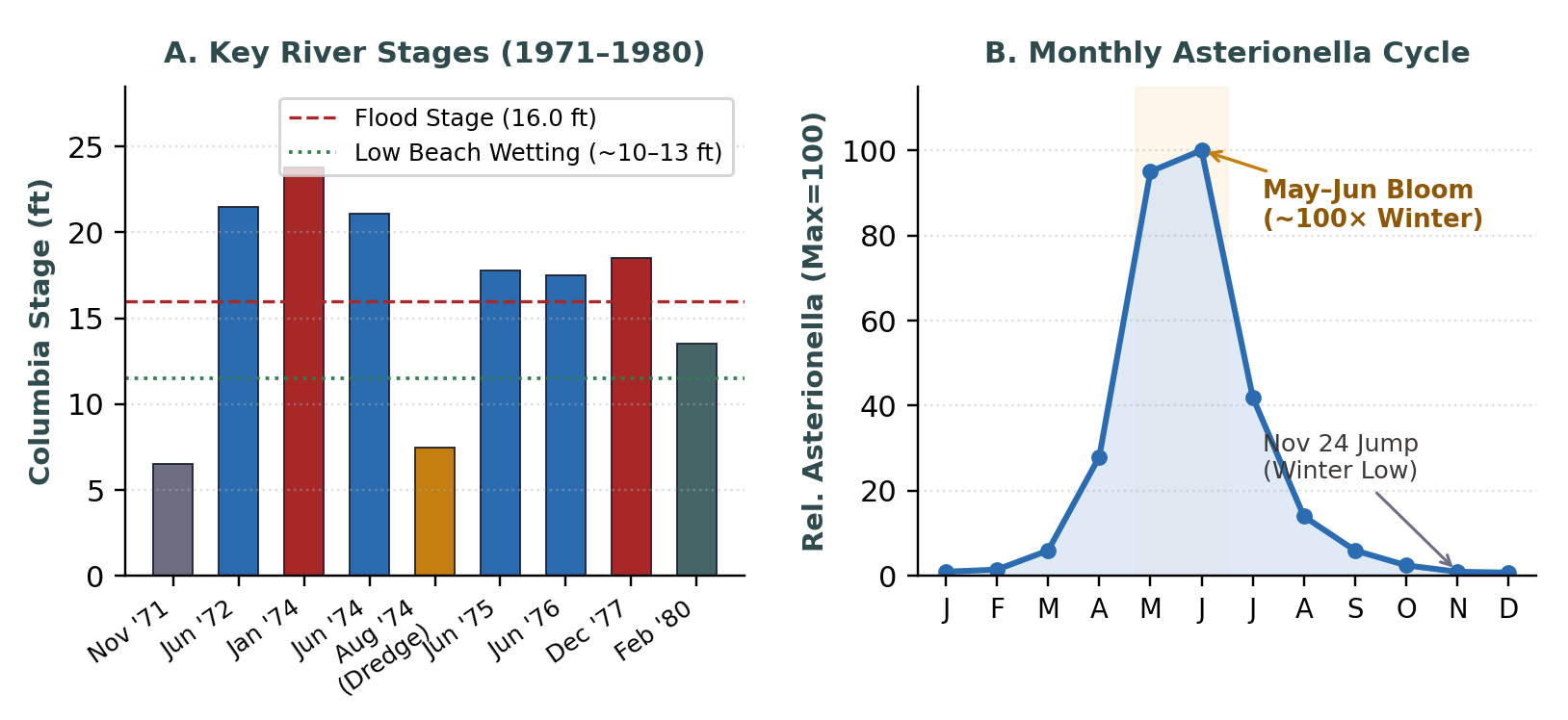
Look at that 8:17:15–8:17:45 PM row [inference]: in late November 1971, low floodplain benches (10–22 ft elevation) along Hayden Island, Pearcy Island, and North Portland were dry land; winter rain carries zero river algae. Then on June 12, 1972, the highest spring freshet of the 1971–1980 decade crested at 21.50 feet at Vancouver (NOAA Gauge VAPW1), submerging those benches under diatom-rich June water. Yet even this lone natural survivor pays three heavy tolls: (1) overriding the 8:11 PM sled-test bump while the crew made calm ATC calls at 8:13:14 and 8:15:52 PM with no second bump (36 / 18 / 6241), (2) keeping rubber bands intact across 8+ years to 1980 (Gate 5), and (3) shedding a cord-lashed canvas bag and 97 sibling packets while landing three packets side-by-side (Gate 3).
Gate 3: Why Three Banded Stacks? Cabin Tips, Sea-First's $250k Reserve & Reel 1B(3)
To pass Gate 3, any delivery explanation has to account for selective three-bundle survival: Cooper left Flight 305 with 100 packets of $2,000 ($200,000, weighing 19 lbs) inside an 11 × 12 × 6.5 inch white canvas bank bag tied shut with parachute shroud lines (11 / 123 / 2026; 110 / 53–54 / 343–344). How did three $2,000 clumps (~$5,800) end up side-by-side in one campfire pit—still wrapped in rubber bands—with zero canvas bag, zero parachute cord, and none of the other 97 packets anywhere nearby?
Sea-First's $250,000 Emergency Reserve ($230,000 in $20s) & Bill Grinnell's Five-Pack Bricks
Why do some FBI memos cite a $250,000 bank reserve while others cite $230,000? Primary microfilm records reconcile both numbers cleanly: Seattle-First National Bank's Main Office kept an emergency extortion reserve of "$250,000 worth of notes, in various denominations" photographed on a single microfilm reel (10 / 459 / 1692; 14 / 387 / 3762; 41 / 33 / 11401). Of that $250,000 total, $230,000 consisted of used $20 bills (115 packets of $2,000 each) and $20,000 consisted of other denominations. Because Cooper received $200,000 exclusively in $20 bills (100 packets), $50,000 stayed behind at Sea-First: 15 packets ($30,000) of $20 bills plus the untouched $20,000 in other denominations. On December 2, 1971 (12 / 3–4 / 2615–2616), Sea-First reported the twenties were "selected at random and without sequence ... banded with Seattle-First National Bank or Federal Reserve Bank bands or quite possibly banded with bands from other banks," matching Tina Mucklow's observation of "bank-type bands around each package" (110 / 44 / 334). Not one 1971 file mentioned rubber bands, and in 2004 Seattle FBI still guarded how the money had been packaged as "holdback details" (52 / 209 / 21879).
In 2020s interviews recorded by Cooper researchers Chris Cunningham and Ryan Burns and at CooperCon 2023, Sea-First messenger-turned-security-investigator William Charles "Bill" Grinnell (1946–2025, Obituary), who rode with the ransom to Sea-Tac (12 / 180 / 2316), and his wife Judy Grinnell recalled that Sea-First strapped 100 twenties ($2,000) in paper currency straps and rubber-banded five $2,000 straps together ($10,000) at either end of the stack (Grinnell Brick Account; ABA Strap Standards). Notice how the bank's $20-bill counts divide cleanly by five: 115 packets pre-filmed (23 × 5), minus 15 held back (3 × 5), left 100 delivered (20 × 5) (14 / 387–388 / 3762–3763) [inference], and water-soluble glue on paper straps dissolves in water leaving only outer rubber bands. (One forum commenter asserts Case Agent Larry Carr interviewed Grinnell in 2008 and heard he only transported the bag, r/dbcooper Dispute, though zero "Grinnell" FD-302s appear in the 122-part Vault.) Either way, finding three clumps at Tena Bar rather than five raises a direct question: did Cooper alter a bundle in flight?
What Cooper Offered Tina Mucklow & the Crew—and Did He Alter a Bundle in Flight?
Checking every stewardess interview in the Seattle prosecutive report (Part 110) reveals two separate tip offers—a distinction even the FBI's 1973 profiler missed when writing that Cooper "did not offer them ransom money as the tip, but used his own money" (41 / 16 / 11384):
- Offer #1 — Under $20 in Pocket Drink Change to All Three Stewardesses ($0 Ransom Touched): Before takeoff in Portland, Cooper ordered a bourbon and 7-Up from Florence Schaffner and paid with his own $20 bill (110 / 25 / 315). Later on the ground at Sea-Tac, while Tina Mucklow carried parachutes aboard, Cooper "offered her [Schaffner] and the other stewardesses on the flight, money which was change from the $20 bill he had given her for the drink. She told him that they did not accept tips" (110 / 29 / 319; copy 10 / 449 / 1682). Mucklow independently recalled "that at one time during the flight the hijacker had pulled some single bills from his pocket and had attempted to tip all the girls on the crew" (110 / 44 / 334). Those "single bills" were $1/$5/$10 change from his drink, not peeled off a ransom strap.
- Offer #2 — One Complete $2,000 Ransom Package (100 Bills) Handed to Tina Mucklow: Right after Mucklow dragged the white canvas bank bag to Seat 18-E (~5:46 PM) and saw "small packages with bank-type bands around each package," Mucklow joked "that there was obviously a lot of money in the bag and she wondered if she could have some. The hijacker immediately agreed with her suggestion and took one package of the money, denominations unrecalled by [Mucklow] and handed it to her. She returned the money, stating to the hijacker that she was not permitted to accept gratuities or words to that effect" (110 / 44 / 334).
What This Proves About Bundle Alteration: No witness saw Cooper break a $2,000 strap for loose twenties—Tina was handed one whole, still-strapped $2,000 package and returned it intact. However, under Grinnell's five-pack layout, Cooper pulling one $2,000 strap out for Tina—and later pulling packets out while trying to repack the ransom into an unfolded parachute and a cut-open chest pack before stuffing them back into the canvas sack (110 / 47–48, 54 / 337–338, 344)—means Cooper physically broke into at least one $10,000 five-pack in Row 18, which could leave a partial three-packet brick or loose packets separated from the main load [inference].
Reconciling the Lab's "~290 Bills" Against All 318 Serial Entries in Part 97
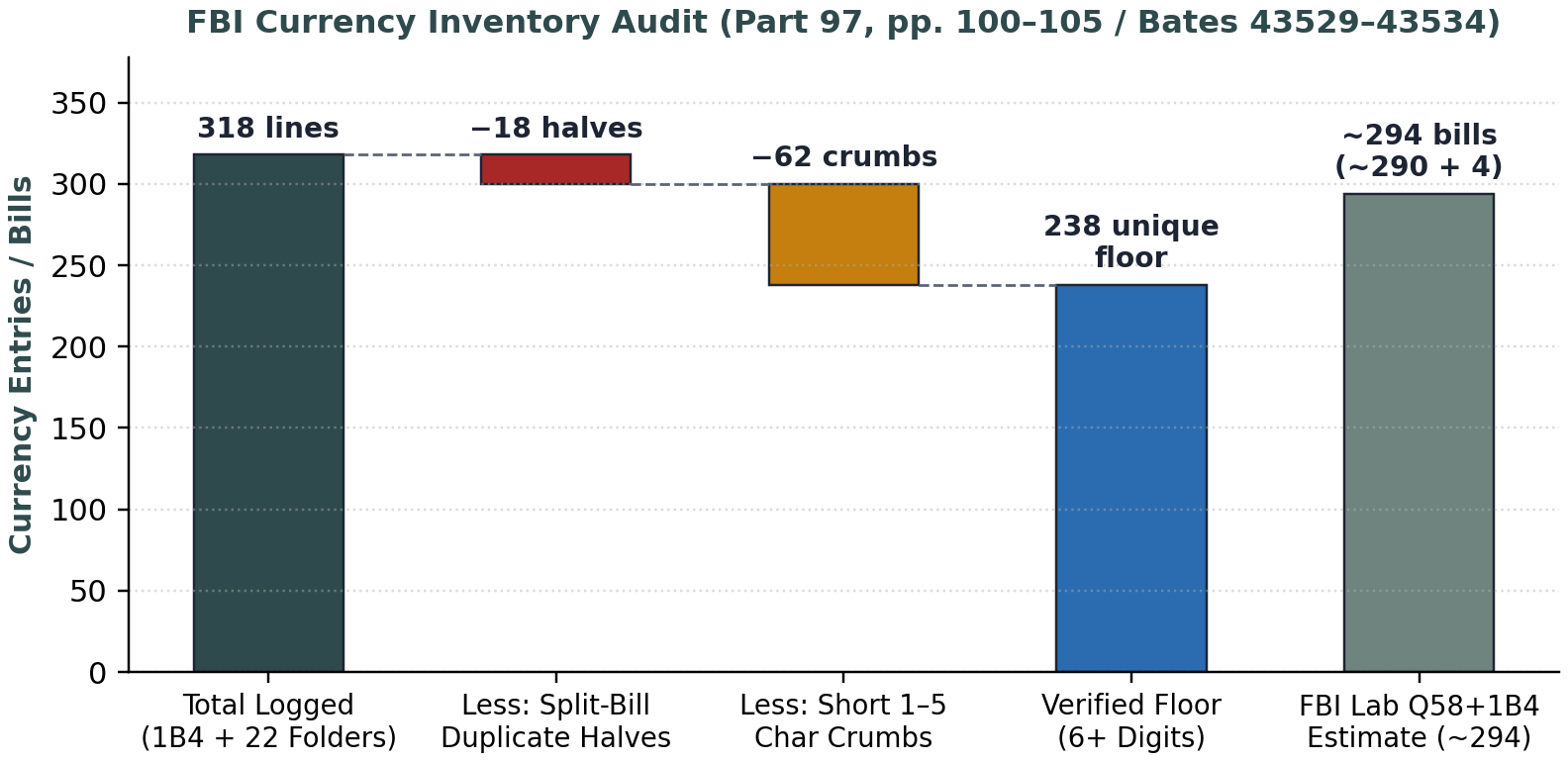
Why did the FBI Lab log Q58 on February 25, 1980 as "Approximately 290 twenty dollar bills ($5,800.00)" (Lab #00214031, 43 / 281 / 17504) rather than 300? Simply because outer edges had rotted and fused: as Portland SAC William M. Baker wrote on November 4, 1982, "the Federal Bureau of Investigation Laboratory could not determine exactly the number of bills contained in the currency submitted" (97 / 21 / 43429). Unidentifiable perimeter crumbs went into separate bulky exhibit PD 164-41-1B5 (later marked "RETURNED / DESTROYED", 90 / 56 / 40039), the four intact souvenir bills became 1B4 (90 / 54 / 40037), and Q58 returned in 22 plastic folders as 1B3 (90 / 52 / 40035). Reconciling every line of the FBI's six-page January 1986 inventory (97 / 100–105 / 43529–43534) against the 1971 ransom booklet (Part 55) is consistent with three full 100-bill packets—including one rare 3-bill consecutive triplet (L34342545A, L34342546A, --4342547A, 55 / 180 / 23324) scattered across Folders #22, #6, and #3 during Lab drying:
The Unread 16mm Photographic Reel (SE 164-81-1B(3)): Every Ransom Bill Photographed in Exact Stack Order
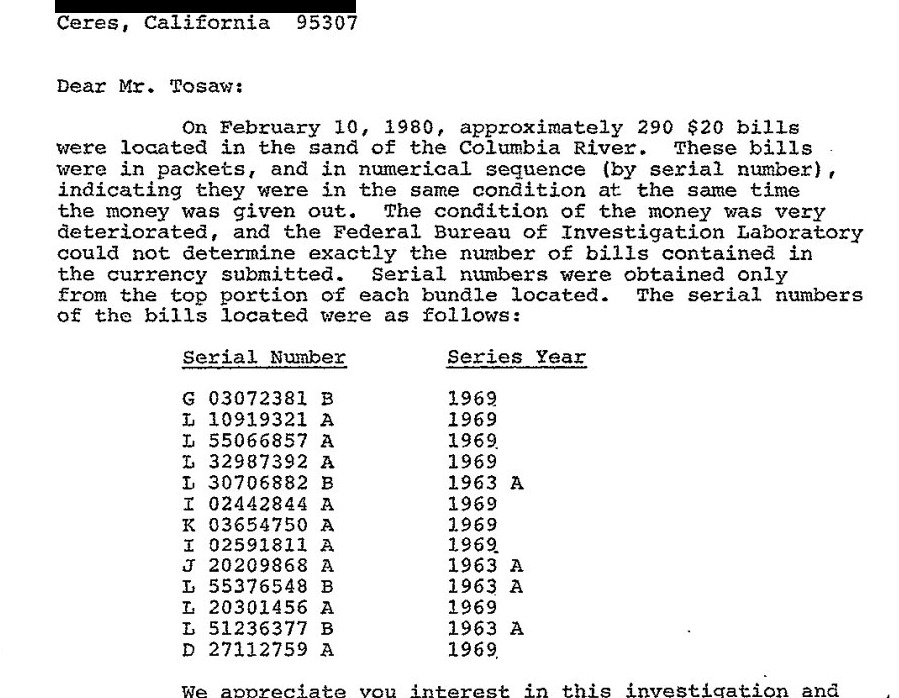
Did the FBI ever verify its Day-1 claim that the Tena Bar bills were "IN MUCH THE SAME ORDER AS WHEN GIVEN TO THE HIJACKER" (9 / 199 / 903; 43 / 128 / 17331)—or SAC Baker's mistaken 1982 statement that random circulated twenties "were in packets, and in numerical sequence" (97 / 21 / 43429, Figure 3)? No—yet the exact photographic record needed to test it is still in FBI custody.
To be clear about what that reel is: it is not a VHS or motion-picture videotape of tellers stuffing a bag. It is a developed roll of 16mm Recordak bank microfilm holding sequential still photographs of all 11,500 pre-staged $20 bills in the exact sheet-by-sheet packet order they sat in Sea-First's vault:
- How the 16mm still-photo strip was shot (29 / 196 / 10264; 10 / 459 / 1692): Before the hijacking, a Seattle-First employee fed all 115 pre-staged $2,000 packets ($230,000 in used $20s) through a Recordak Model RW600 rotary bank microfilmer—blocking out the back and half of the front face while photographing the serial-number half of every bill flat onto 16mm film ("for use in a Recordak Reliant 600K microfilm viewer").
- Why "between first and last" meant camera frames, not numerical order (10 / 459–460 / 1692–1693; 11 / 330 / 1805): When Sea-First held back 15 packets ($30,000), it gave the FBI only the 1st and 100th serial of each kept strap—most jumping across Federal Reserve districts (e.g., B 07656937B through L 05419634A, and C 05722105A through G 16813690A)—and told clerks to skip "the 98 serial numbers contained between each" on the film strip. Every 100 consecutive frames on that film records one physical $2,000 packet.
- Both Seattle's reel (1B(3) / K4) and Bureau paper copies were kept (21 / 8–11 / 6231–6234; 25 / 145, 237 / 8123, 8221; 29 / 9 / 10063): On January 25, 1972, FBIHQ advised Seattle "that copies of the bills contained in this microfilm were retained at the Bureau" (21 / 8 / 6231), while Seattle kept the original reel indefinitely as 164-81-1B(3) (21 / 10–11 / 6233–6234; used as Lab K4 in May 1972 and returned Nov. 29, 1972, 29 / 9 / 10063). Because the FBI alphabetized the 34-page public booklet (Part 55), erasing packet order, obtaining 1B(3) or FBIHQ's retained copies via FOIA could quickly show whether Tena Bar's bills came from three intact $2,000 packets and a single $10,000 five-pack.
Gate 4: Spring Diatoms, Zero Silt & Whether Algae Can Penetrate Sand
In August 2020, Tom Kaye and Mark Meltzer published a scanning electron microscopy (SEM) study of an untreated Tena Bar fragment from Brian Ingram (Kaye & Meltzer 2020, Scientific Reports 10:13036). Unlike three FBI-held fragments stripped barren by silver-nitrate fingerprint washes (Latent Case No. A-45410, 45 / 125 / 18234; Citizen Sleuths), the untreated note held six freshwater genera of diatoms (microscopic river algae whose ornate glass shells, or frustules, survive after death) up to 24 mm inside the rotted margin: Asterionella (16.10 cells/cm², 66% of all counted shells—a classic May–June bloomer), Fragilaria (2.98 cells/cm²), Stephanodiscus (1.79), Cyclotella (1.79), Cymbella (1.19), and Melosira (0.60). Keeping in mind that testing one bill carries sampling limits, Gate 4 audits two distinct questions.
4A. Why Spring Diatoms and Clay-Free Paper Point to a Springtime Wetting
Taken by itself, a spring-dominated diatom count does not rule out an earlier winter soaking. Lower Columbia plankton surveys (Breckenridge et al. 2015; Maier & Peterson 2014) show the river has no winter-exclusive diatom species, and May–June Asterionella blooms (103–104+ cells/mL) outnumber sparse November–February populations (<10–102 cells/mL of year-round Stephanodiscus, Melosira, and Cymbella) by 100:1 to 1,000:1. A bill soaked in winter (~1–2 background shells/cm²) and still exposed in May–June (+16 Asterionella shells/cm²) produces the same species list as a bill wetted only in spring.
A spring diatom signature also does not require mountain snowmelt. In the Lower Columbia, Asterionella formosa blooms every May and June in response to longer spring daylight and warming water, even in low-snowpack years (Rose et al. 2021). High snowmelt stage matters only if river water had to climb twenty yards up the beach to reach an already-buried stash; if the bills got wet near the shoreline first, ordinary May–June river water carries the same bloom.
What points away from a winter storm soaking is the missing mud. Winter high water in the Lower Columbia and its tributaries comes from lowland rainstorms washing eroded soil, clay, and fine silt into the river (Sullivan et al. 2001)—fine sediment that wicks into wet cotton-linen paper and stays trapped between the sheets. Yet FBI Lab mineralogist Chris Fiedler reported of Q58, "What we didn't find, is clay or other substances"—only clean, water-rounded quartz river sand (43 / 327, 426–427 / 17555, 17675–17676 [press]). Pairing dense May–June Asterionella colonies (66% of counted shells) with clean, silt-free paper points toward wetting in spring or early summer rather than during a muddy winter flood [inference].
4B. Can Diatoms Penetrate the Sand? Why Star Colony Size Makes Penetration Unlikely
Can river diatoms trickle down through beach sand after dry money is already buried? That is the core test for any dry human-burial theory: if someone buried dry stacks 4 to 8 inches deep on Tena Bar, and a later May–June high stage covered the beach, could bloom water seeping down through the sand carry Asterionella inside the buried bills?
| Physical Parameter | Measured Dimension | Sand-Filtration Consequence |
|---|---|---|
| Tena Bar Quartz Sand (median d50 & finest-10% d10) | d50 ≈ 250–400 μm; d10 ≈ 150–220 μm | Clean, water-rounded Lower Columbia bar sand (43 / 327 / 17555; USGS SIR 2018-5161) |
| Sand Pore-Throat Gap (0.155 × d, gap between grains) | Packed sand: 23–62 μm · Loose swash: 50–165 μm | Packed sand strains out >95–99% of particles >30 μm within 2–8 cm depth [inference] |
| Single Asterionella Needle | Length: 45–85 μm · Width: 1.1–4.5 μm | Slender silica rod (Diatoms of North America) — could slip lengthwise through shallow sand |
| Intact Asterionella Star Colony (4–8 cells) | Pinwheel span: 100–160+ μm across | Photographed intact 24 mm inside the Tena Bar bill (Kaye & Meltzer 2020, Figs. 2–3) — blocked/sheared by packed sand |
In a live May–June Columbia bloom, Asterionella formosa links at the tips via fragile mucilage pads into sprawling 4-to-8-cell pinwheel ("star") colonies measuring 100 to 160+ μm across—and Kaye & Meltzer photographed intact multi-cell star colonies 24 mm inside the Tena Bar bill. Flushing a delicate 100–160 μm glass pinwheel intact through 23–62 μm sand throats across several inches of sand—while wet sand weight (~30 g/cm²) pinches saturated $20 sheets shut—is like trying to wash an open umbrella intact through a chain-link fence (80 μm Fragilaria penetrated only 3–4 mm under just 2 cm of static sand in Kaye & Meltzer 2020). Our conclusion [inference]: the large size of intact star colonies makes passive seepage through undisturbed burial sand unlikely. Either the stacks got wet directly in open spring river water before burial, or June flood waves scoured away nearly all overlying sand ("about 3 inches down", 43 / 204 / 17412) so splayed margins met open bloom water directly before sand covered them again.
Gate 5: Why Rounded Corners & Crumbling Bands Point to Stationary Burial
To pass Gate 5, a theory must explain the exact physical state of the Tena Bar cache in February 1980 (Figure 5): all three clumps had symmetrically rounded, eaten-away outer corners around intact, fused central portraits, while the rubber bands still circled each stack in the sand yet "CRUMBLED AND FELL AWAY UPON BEING HANDLED" (96 / 304 / 43238).
Casual observers often assume rounded corners mean the stacks tumbled down a riverbed like smooth stones. Both polymer science and real-world recoveries of lost paper currency point the other way:
- 3-Plane Stack-Shielding Geometry vs. Oxygenated Decay Speed: U.S. currency uses 75% cotton / 25% linen rag paper wet-strengthened with ~3% melamine-formaldehyde resin (PMC4877150; NIST T329). In any compressed 100-bill stack rotting motionlessly, flat inner faces shield each other, straight sides suffer 2-plane microbial attack, and the four 90° corners suffer 3-plane attack—rounding rectangular bricks into smooth ovals with zero river tumbling (PMC8779040). Oxygen sets the speed: in Citizen Sleuths' sealed anoxic river-water jar, microbes suffocated and zero rot occurred in 33 months (Money Analysis); in warm-season, oxygenated damp beach sand, aerobic microbes carve that rounded-corner, fused-core shape in ~2 to 6 years [inference].
- Zero-Tension Rubber Chemistry: Stretched rubber bands snap in 234–355 days in sunlit outdoor air (Rubber Band Analysis), though dark, cold PNW winter shade or a bag shields rubber longer. Once buried undisturbed in dark, wet sand, vulcanized rubber undergoes Tobolsky oxidative stress relaxation (PMC6756245; Canadian Conservation Institute): polymer chains sever and re-link at zero tension, leaving a brittle ring molded around the stack that shatters at the slightest river tumble or bluff collapse.
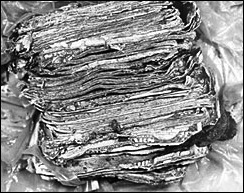
FBI photo: "One of the packages of currency comprising part of the Brink's loot found in the wall of an office on Tremont Street in Boston, MA in June 1956."
On January 17, 1950, seven masked gunmen took $1,218,211 in cash from Brink's in Boston. In June 1956, a "musty" $10 bill passed in Baltimore led agents to a picnic cooler behind an office wall on Tremont Street. The cooler held more than $57,700, including $51,906 traced to the robbery by serial number. The cash sat in $5,000 packages wrapped in plastic and newspaper and was "in various stages of decomposition": some bills were in pieces, and others fell apart as they were handled.
The FBI Laboratory found that the decomposition, discoloration and matting were due at least in part to the bills having been wet. It also found the packages were damaged before they were wrapped, and that there were indications they had been "in a canvas container which was buried in ground consisting of sand and ashes." Mold and insect remains were on the loot.
Why it matters for Tena Bar: It is the only case we found in which the FBI Lab itself examined banded currency packages that had been buried wet in sandy ground, over part of a six-year span comparable to Tena Bar. The stacks came out fused and decayed, yet still whole as packages rather than scattered loose bills. Two differences matter: people buried the Brink's money inside a canvas container and dug it up again before it was found, and the FBI photos do not show Tena Bar's smooth oval corners, possibly because the canvas shielded the stacks [inference].
Source: FBI, "The Brink's Robbery," FBI famous-cases history (archived Jan. 17, 2009, UNT Web Archive). Photo: FBI.
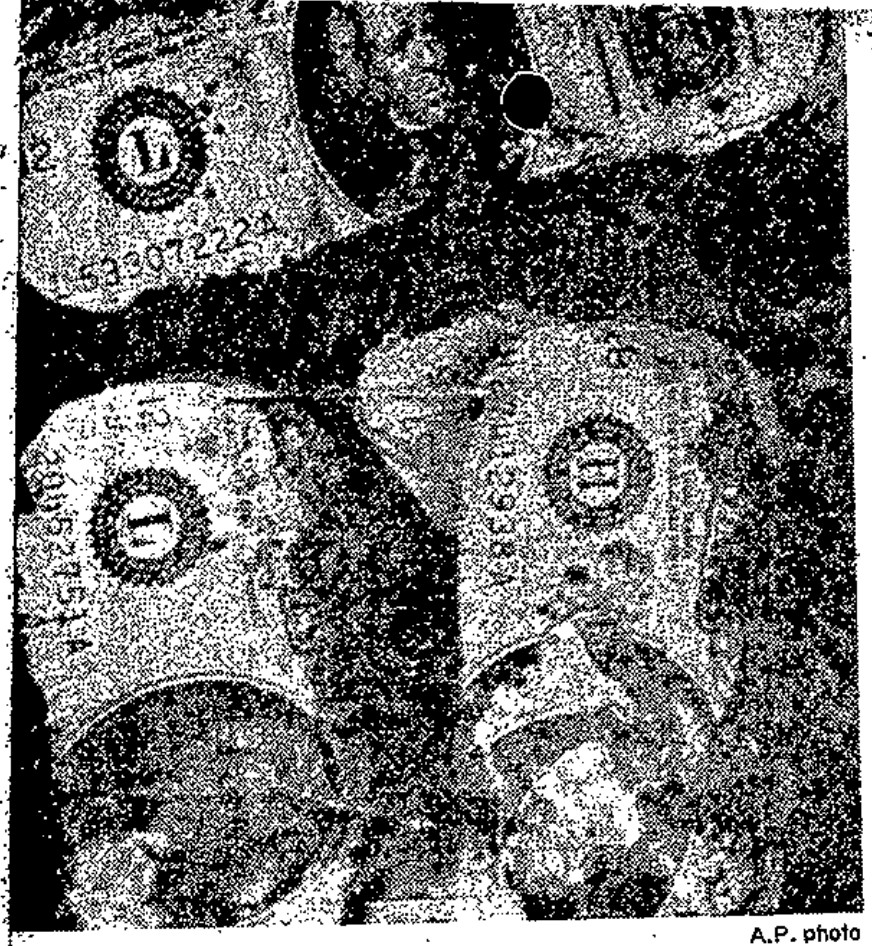
5A. Cooper's Three Tena Bar Clumps (96 / 295 / 43229): Feb. 1980 AP overhead photo before separation—top bills H27412938A (Folder #7), L20452751A (Folder #11), and L53307222A (Folder #17) show smooth 4-corner oval rounding around intact seals and portraits.
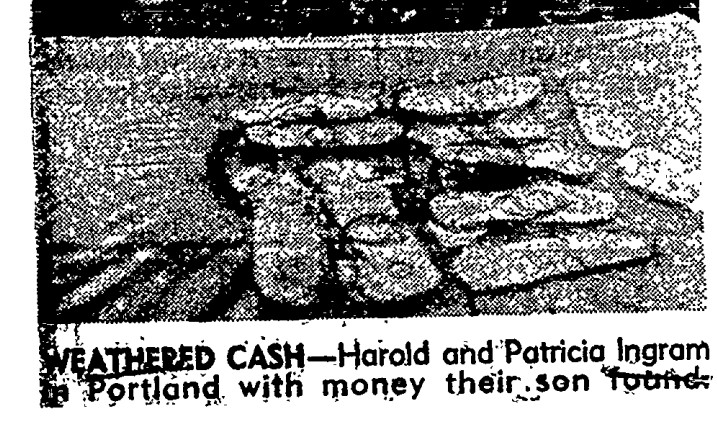
5B. Portland FBI Display Table (43 / 160 / 17364): Oval, edge-eaten Tena Bar stacks displayed in front of Harold and Patricia Ingram prior to FBI Lab blotter-and-tweezer peeling (43 / 427 / 17676).
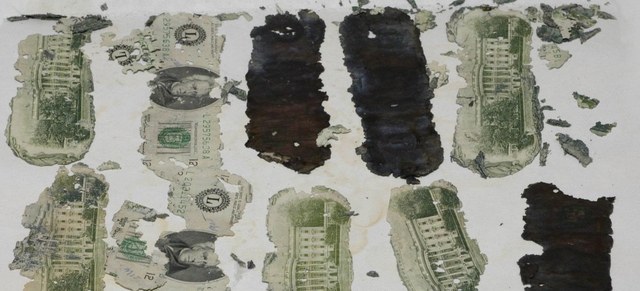
1. Tena Bar $20s (1971–1980)
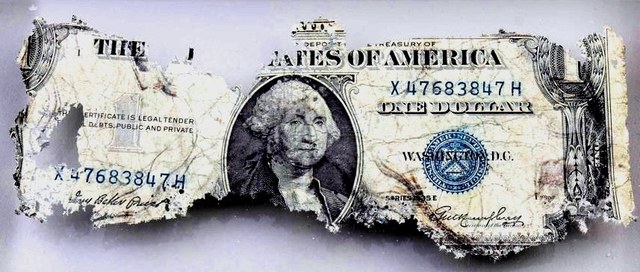
3–8 in. of damp beach sand: corners eaten into ovals and dogbones around sharp centers and serials.
FBI photo (public domain), Wikimedia Commons
2. SS Andrea Doria Safe (1956–1981)
25 yrs in a motionless steel safe at ~240 ft: all four corners and margins eaten away; portrait and serials intact.
1935E $1 X47683847H, PCGS Grade C · EBTH
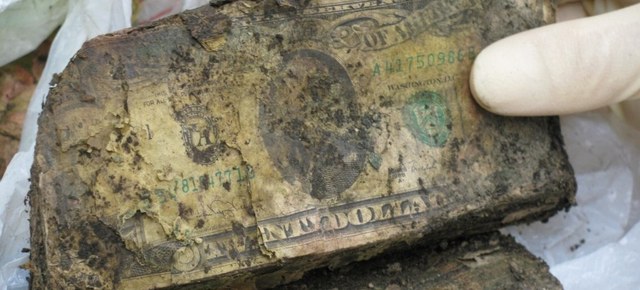
3. BEP Buried & Water-Fused Bricks
Damp storage fuses 100-bill stacks into solid "petrified" bricks that BEP examiners separate by hand.
U.S. BEP photo, via TIME for Kids
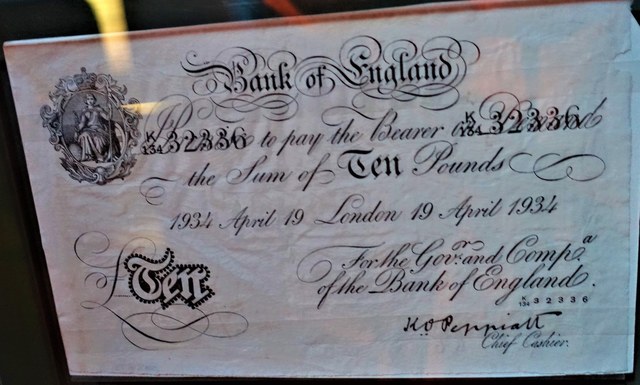
4. Lake Toplitz Chests (1945–1959)
14 yrs in crates in an oxygen-poor alpine lake: the forged notes came up readable, with little edge loss reported.
Bernhard forgery, Intl. Spy Museum · CC BY-SA 4.0
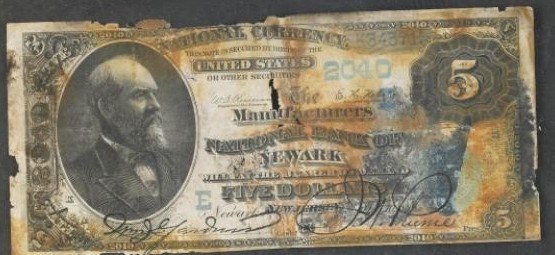
5. RMS Titanic $5 Note (1912–1987)
75 yrs at ~12,500 ft: heavily stained, but the corners are still close to square.
RMST 87/0097.A · National Museums Liverpool
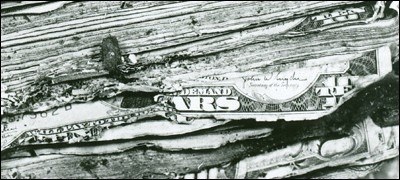
6. Brink's Loot, Boston (1950–1956)
Wet $5,000 packages once buried in canvas in sand and ashes: decomposed, discolored and matted together (FBI Lab).
FBI photo (public domain), FBI Brink's Page
What Each Comparative Wild-Money Case Was—and What It Shows
- Brink's Loot, Boston (1950–1956): The FBI Lab found that $5,000 packages, wet and buried in canvas in sand and ashes, had decomposed, discolored and matted together, with mold and insect remains (FBI, The Brink's Robbery).
- SS Andrea Doria Safe (1956–1981, Opened 1984): Divers raised the liner's Banco di Roma safe from about 240 feet in 1981, and it was opened on live TV in 1984 (Christian Science Monitor 1984). The notes never moved, yet the worst $1 Silver Certificates (PCGS Grade C) lost all four corners and most of their margins around readable centers, like Tena Bar's but more ragged (EBTH).
- Bureau of Engraving & Printing (BEP) Buried Cash: BEP handles more than 22,000 damaged-money claims a year, many from cash that was buried or stored damp (BEP; TIME for Kids). Damp storage fuses 100-bill stacks into "petrified" bricks that examiners separate by hand, as the FBI Lab's Documents Section separated the Tena Bar bills with blotter paper and tweezers (43 / 427 / 17676 [press]).
- Lake Toplitz Chests (1945–1959) & RMS Titanic $5 Note (1912–1987): Crated Nazi forged pound notes raised from oxygen-poor Lake Toplitz after 14 years (Operation Bernhard), and a $5 note from the Titanic debris field after 75 years (RMST 87/0097.A; National Museums Liverpool), kept nearly square corners. That is consistent with Tena Bar's edge loss forming in shallow, oxygenated sand over roughly 2 to 6 years [inference].
Gate 6: Sinking Bills, January 1979 River Ice, the 1974 Dredge & Palmer's Clay Layer
To pass Gate 6, a waterborne or mechanical theory has to solve two physical problems at once: how negatively buoyant wet currency reached a high sandbar twenty yards above the winter waterline, and how it ended up buried 3 to 8 inches beneath heavy quartz sand (43 / 204, 218 / 17412, 17427 [press]).
6A. Does Money Float? Empirical Flotation Data on Currency & the Canvas Bag
In February 1980, newspaper stories and even the Army Corps' back-of-the-envelope Washougal travel estimate casually spoke of a package having "floated in the main stream" or "floated onto the beach" (43 / 219, 379 / 17428, 17615). Material physics and direct tank and river experiments show the opposite—soaked currency and an unsealed canvas bank bag do not float at all:
| Material / State | Specific Gravity | Measured Water Behavior & Primary Source |
|---|---|---|
| Dry $20 Strap (100 bills) | ~0.88 g/cm³ | 6.14 × 2.61 × 0.0043 in., 1.0 g (St. Louis Fed); ~42% dry pore air gives brief surface float of only a few minutes under agitation (Citizen Sleuths). |
| Freshwater Ice / River Water | 0.92 / 1.00 g/cm³ | Neutral-buoyancy cutoff = 1.00 g/cm³; river ice (0.917 g/cm³) floats and can raft frozen sediment (USACE EM 1110-2-1612). |
| Saturated $20 Stack | ~1.20–1.25 g/cm³ | 75% cotton / 25% linen cellulose fiber is 1.52–1.54 g/cm³ (CottonWorks); once pores flood, stacks sink to the riverbed and halt in quiet pools (Washougal Test). |
| Wet Canvas Bank Bag (Full) | ~1.30–1.36 g/cm³ | 19–21.25 lb load (60 / 300 / 24985; 54 / 75 / 23001) in porous cotton duck (Fabric Weave) tied with shroud cord (110 / 54 / 344) vents air and plunges like an anchor [inference]. |
| Tena Bar Quartz Sand | 2.65 g/cm³ | More than twice as dense as wet paper: river currents strong enough to move sand wash lighter unanchored bundles away first (CooperCon Hydrodynamics). |
In Fall 2008, Tom Kaye's team tested rubber-banded 100-bill stacks in a water tank and in the live Washougal River (Money Analysis; Washougal Washdown Theory). Any water agitation sank the bundle in minutes as outer sheets fanned open; in fast river current a tethered stack bounced along the rocky bottom and immediately sank motionless upon entering quiet water, while untethered bundles snagged or lost their rubber bands and scattered within 5.5 miles. Once on a sandbar, that density gap between wet paper (~1.22 g/cm³) and quartz sand (2.65 g/cm³) creates a catch-22: open river currents fast enough to mobilize heavy sand grains sweep unanchored paper stacks off the bar rather than burying them.
6B. Could an Ice Dam or the January 1979 Columbia Freeze Have Rafted the Cash Ashore?
What if river ice supplied the missing buoyancy? In cold-river geology, shore-ice and anchor-ice rafting (USACE EM 1110-2-1612; USACE EM 1110-2-4000) is a documented mechanism for lifting sunken objects off a riverbed: ice (0.917 g/cm³) freezes around shallow bottom debris—just a four-pound slab of ice can float three soaked $2,000 stacks—locks fragile edges and rubber bands rigid so they never tumble, and strands on outer bends like Tena Bar (RM 96.9). Moreover, the Lower Columbia actually carried heavy metro-area ice during the 1971–1980 window—most notably during the January 1–14, 1979 Gorge freeze (thirteen months before Brian Ingram's find, when fourteen sub-freezing days and the Jan. 9–10 "Silver Thaw" froze sections of the Columbia above Bonneville Dam and choked Portland–Vancouver river traffic with heavy ice floes; Weatherwise 1979; Jan. 10, 1979 AP Summary; Oregon AMS Gorge Archive, p. 68), alongside sharp freezes in December 1972 (FOX 12 Archive) and January 8–12, 1980 (15 inches of Vancouver snow plus freezing rain a month before discovery; Vancouver 1980 Weather; Monthly Weather Review 1980).
While ice rafting neatly solves transit buoyancy and rubber-band abrasion, four physical hurdles still rule it out as a standalone answer [inference]: (1) ice floes still drift downstream, and an ice dam below RM 87.0–87.5 could never back water 9.4 miles upriver to Tena Bar without flooding Woodland, Ridgefield, and North Portland (which never happened), so the cash still had to start upstream of RM 96.9; (2) winter ice misses spring diatoms and clean paper—if Jan. 1979 or Jan. 1980 ice stranded the stacks, dry spring 1979 (83.1 MAF, USACE WY97) never rose high enough to add May–June Asterionella, while shore ice normally freezes in bank mud and gravel absent from Q58 (43 / 426–427 / 17675–17676); (3) decay timing clashes at both ends—a Jan. 1979/1980 arrival leaves only 1 to 13 cold-weighted months on the beach (too short for 2–6 years of bacterial corner rounding, Money Analysis), whereas a Dec. 1972 melt leaves bare stacks sitting in open sun where rubber bands snap inside a year (Rubber Band Analysis); and (4) melting ice drops its cargo exposed on top of the beach, never 3 to 8 inches beneath clean sand.
6C. Why the August 1974 Dredge "Washington" Could Not Have Pumped Up the Cash
Between August 19 and August 25, 1974, General Construction Company's pipeline suction Dredge "Washington" pumped 91,100 cubic yards from the 40-foot shipping channel (RM 96+38 to RM 97+17) onto Tena Bar (96 / 300–301 / 43234–43235; 43 / 374–376 / 17609–17611; neighboring Fazio Bros. mined sand out of RM 97.4–98.8 rather than dumping sand onto Hans Egger's beach, 43 / 175–176, 184, 212 / 17380–17381, 17389, 17420; WA Ecology Notice 28487). Passing a rotating cutterhead auger, an internal 24-inch pipe "wiper bar", a centrifugal slurry pump, and beach bulldozers after 2.7 years underwater would shred wet paper and snap weakened rubber bands instantly. Worse, even if a closed canvas bag sacrificed 97 packets (9,700 bills) to shield 3 inner packets, mixing 9,700 shredded twenties into 91,100 cubic yards yields one shredded $20 bill in every 9 cubic yards of beach sand—yet six days of FBI sifting screens and backhoe trenches (43 / 153, 209 / 17357, 17417 [press]; 78 / 409 / 34287 [press]) found zero widespread confetti and zero shredded canvas bag outside the firepit [inference].
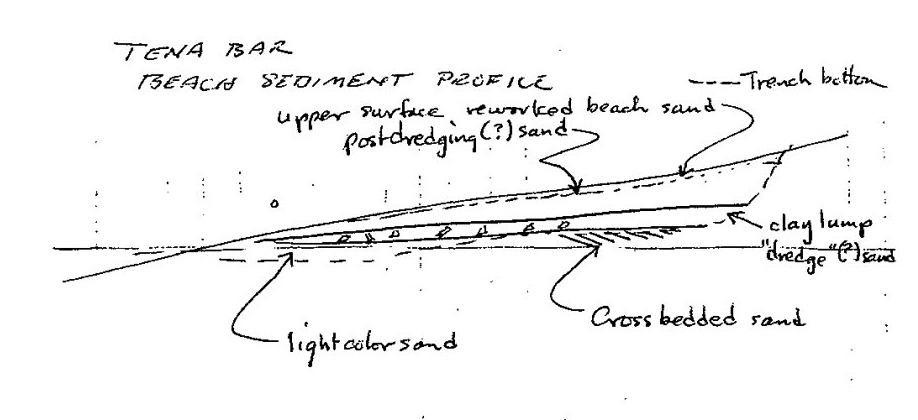
6D. How Dr. Leonard Palmer's "1974 Dredge Layer" Lock Was Proven Wrong
For thirty years, even researchers who rejected dredge pumping treated August 1974 as an unbreakable floor because PSU geologist Dr. Leonard Palmer (96 / 309–312 / 43244–43247; Figure 6) hit a clay-rich horizon ~2 feet down in his 1980 trench and guessed it came from the August 1974 dredging—implying the cash above it had to arrive after 1974. Modern field evidence overturned Palmer's 1974 clay-floor assumption on two fronts (Citizen Sleuths — Palmer Report; Tena Bar Money Find):
- Natural Shoreline Clay Beds Exposed in 2009: When the Citizen Sleuths team surveyed Tena Bar in March 2009, severe multi-decade wave erosion had stripped several feet of beach sand down to the tree roots—exposing continuous, alternating natural strata of consolidated clay and clean sand running the entire length of the beach at the exact depth of Palmer's 1980 pit (Palmer Report). Looking into a narrow trench in 1980, Palmer mistook a natural Columbia River clay bed for man-made 1974 dredge spoil.
- 1974 Aerial Photos Showed the Find Lay Outside the 50-Yard Dredge Zone: Dredge records state tractors pushed the August 1974 spoils "probably over an area of 50 yards in each direction" (96 / 301 / 43235). Matching 1974 aerial photos of the spoil pile to the relocated 1980 campfire pit showed the money find sat outside the 50-yard footprint of the 1974 dredge sand (Tena Bar Money Find)—and earlier channel replenishment at Tena Bar had also occurred before November 1971 (1971 Columbian Dredging Note). (Palmer's secondary bluff-slump idea likewise fails Gate 5, since zero-tension bands shatter on collapse.)
What Removing Palmer's 1974 Lock Changes: Geology no longer imposes an artificial "post-August 1974" rule. Earlier spring high-water years (June 1972 and June 1974, alongside June 1975 and June 1976) are stratigraphically open—leaving Gate 5's ~2-to-6-year paper-and-rubber survival clock as the true timeline check.
Gate 7 (Sort of a Gate): Did a Human Bury It?
Strictly speaking, human motive is only sort of a gate—rivers and sand grains do not care why someone acted, and the only reason this question comes up at all is because clearing Gates 1 through 6 seems to require a human burying the money on Tena Bar. Yet the moment you step into Gate 7 (Sort of a Gate) and ask why any rational human being would walk past dairy barns to bury ~$5,800 bare in wet fishing-beach sand, you run headfirst into practical absurdity. Test each major human-burial theory in turn:
1. What Was the November 24, 1976 "John Doe" Indictment (CR 76-229)—and Did It Trigger a Dump?
Many human-disposal theories center on November 24, 1976—the fifth anniversary of Flight 305. Under general federal law (18 U.S.C. § 3282), most non-capital federal felonies—including Hobbs Act extortion (18 U.S.C. § 1951)—expire under a five-year statute of limitations unless a grand jury indicts within five years. Throughout 1975–1976, Northwest newspapers ran public countdowns declaring that after Thanksgiving Eve 1976, "D.B. Cooper will be home free" (9 / 475 / 1199 [press]).
Behind closed doors, however, the Vault files expose an extraordinary bureaucratic mutiny:
- FBIHQ and DOJ Ordered Against a "John Doe" Indictment: At an April 8–9, 1976 NORJAK conference in San Francisco (48 / 33–34 / 19824–19825), agents from all five field offices unanimously warned "that a John Doe indictment at this time would be difficult to obtain due to the lack of positive identifying or even somewhat limiting data concerning Cooper" (no matched fingerprints, no DNA in 1976—only a ticket alias and composite sketch fitting tens of thousands of men), concluding it could harm future prosecution if "thrown out." Meanwhile, DOJ and Seattle's U.S. Attorney ruled (51 / 195, 201 / 21310, 21320) that 1971 air piracy (49 U.S.C. § 1472(i)) was a capital offense carrying no statute of limitations at all (18 U.S.C. § 3281).
- Portland Defied Headquarters at 5:00 PM on Day 1,827: As a candid Seattle FBI memo later recorded (50 / 383 / 21081; Figure 7B), "Despite this fact and direct orders by FBIHQ and DOJ, SA [redacted] indicted UNSUB in Portland in 1976. This is known as a John Doe Indictment and is of questionable legal value." At ~5:00 PM on November 24, 1976 (10 / 81 / 1301), U.S. Attorney Sidney I. Lezak's Portland grand jury returned United States v. JOHN DOE, also known as DAN COOPER, Criminal No. CR 76-229 (24 / 575–577 / 1313–1315; Figure 7A), charging Count I (Aircraft Piracy) and Count II (Hobbs Act Extortion of $200,000), setting a $500,000 bond, and pasting a 73-word eyewitness physical description ("male Caucasian, age mid-forties; height 5'10"–6'; weight 170–180 lbs.; ... olive, medium smooth; ... heavy smoker of cigarettes") where a defendant's name belongs.
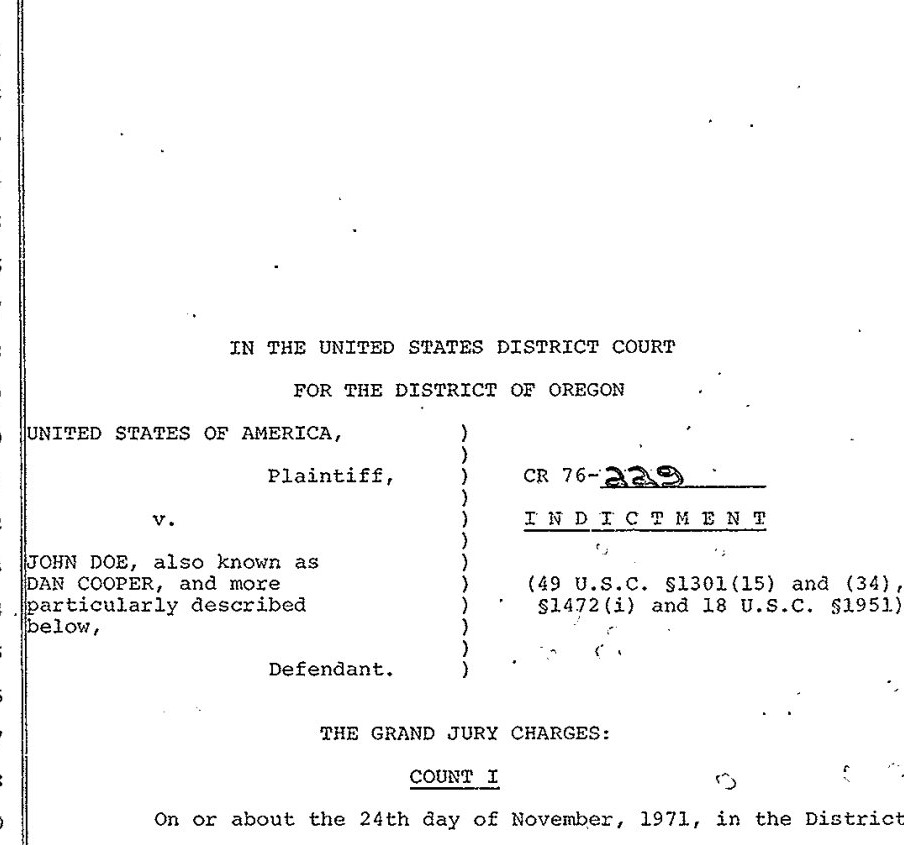
7A. Executed "John Doe" Indictment CR 76-229 (24 / 575 / 1313): Filed at ~5:00 PM on Nov. 24, 1976 using a 73-word physical description in place of a name.
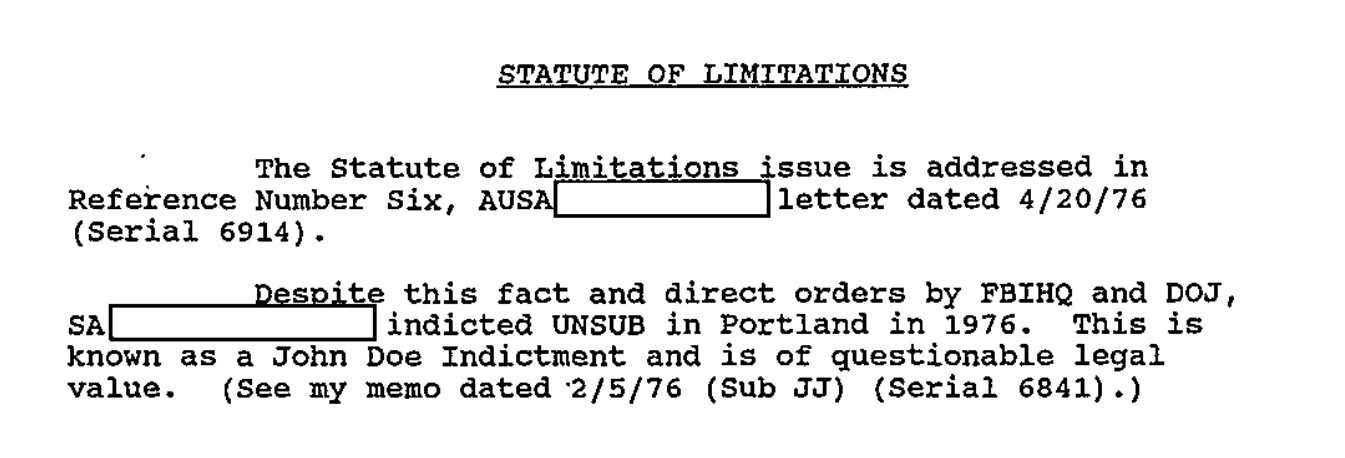
7B. Seattle Statute Memo (50 / 383 / 21081): Reveals Portland obtained the 1976 John Doe indictment "Despite ... direct orders by FBIHQ and DOJ" and calls it "of questionable legal value."
When Thanksgiving 1976 headlines announced Cooper had been indicted after all, any fugitive holding unspendable listed twenties had reason to get rid of them. Yet burning cash in a woodstove or dropping weighted bundles off a bridge makes sense; driving down Lower River Road past Fazio Bros.' buildings to dig a shallow hole on a beach makes none—and as a "faked-drowning decoy," burying bait where nobody found it for years fails completely.
2. The "Tina = Tena" Homage Theory (Distinct Symbolic Gesture)
A second camp proposes a purely sentimental or psychological motive: aboard Flight 305, Cooper was famously polite to 22-year-old stewardess Tina Mucklow and tried to hand her a $2,000 ransom packet as a gift (110 / 44 / 334). When she declined, proponents suggest a surviving Cooper later visited Tina Bar / Tena Bar (9 / 199 / 903) and buried three unspendable packets there as a private symbolic tribute or inside joke to "Tina" (r/dbcooper Discussion). It echoes the cabin tip offer neatly—yet asks us to believe a cautious fugitive risked prison trespassing past farm gates just to bury a private pun (on a bar half the maps spell Tena) where nobody might ever dig. Cooper's actions on the plane did not fit him into a mold that would suggest he was of a poetic or metaphoric mind, and instead everything he did and said pointed to a cold, calculated left-brain thinker, so this seems unlikely [inference].
3. The Buried-Stash & Cryptic-Riddle Theories (Two Distinct Angles)
Separate from a pure sentimental homage is the Buried-Cache / Cryptic-Treasure angle, which splits into two very different ideas:
- Angle A — The "Lost Squirrel-Cache" or Rotted-Stash Retrieval: Cooper, an accomplice, or a third party who stumbled onto part of the loot buried a cache near a memorable Columbia River bend intending to come back once newspaper serial-number rewards cooled off (48 / 34 / 19825; r/dbcooper Stash Analysis). Either (i) annual Columbia floods and beach erosion shifted the shoreline so the burier lost his exact spot and left three loose packets behind (a dynamic river sandbar is a poor safe-deposit box), or (ii) the burier came back years later, dug up a leaky container, saw three outer packets had water-rotted into unspendable bricks, and tossed or left the ruined stacks right there in the sand while walking off with the dry interior cash. With the restrictions imposed from the flight path and jump time, it is difficult to imagine a scenario where Cooper or even an accomplice finds themselves at or near Tena Bar with the money in hand and no better options for stashing it, so this similarly seems unlikely [inference].
- Angle B — Outside-the-Box Cryptic Breadcrumbs & Riddles: With so little making sense for human burial, maybe something outside the box is required to explain the delivery. The connection to "Tina" seems a little too close to be coincidence, particularly when paired with an amount so closely mirroring the potential amount of money he offered her (110 / 44 / 334). What if he left clues, breadcrumbs, or cryptic messaging to someone via newspapers, books, or letters to his identity—or better yet, his loot? What if "Tina's Money" at "Tena Bar" was just a checkpoint in a bizarre line of riddles and puzzles he left for someone to figure out who simply never did, and Brian Ingram stumbled upon it later [inference]? HAHAHA? Is this a book or a joke?
Which Way Does Occam Cut?
Line up every contender across all seven gates on one scorecard, and the core paradox of Tena Bar stares right back at you:
| Contender Explanation | Gate 1: River | Gate 2: Clock | Gate 3: 3 Packs | Gate 4: Diatoms | Gate 5: Rot/ Bands | Gate 6: Burial | Gate 7 (Sort of a Gate) |
|---|---|---|---|---|---|---|---|
| 1. 8:11 PM Jump → Clark Co. Creek / Tide | FAIL (9.4 mi below) | PASS (Point A) | FAIL (scatter) | FAIL (mud) | FAIL (tumble) | FAIL (no path) | PASS (natural) |
| 2. Aug 1974 Suction Dredge Pump-Up | Needs >RM 96.9 | Needs late/ human | FAIL (no confetti) | Possible ('72–'74) | FAIL (shatter) | FAIL (missed spot) | PASS (mech.) |
| 3. Washougal Flood Washdown | PASS (RM 121) | STRAINED (15–22 mi E) | FAIL (24 mi rocks) | STRAINED (spring) | FAIL (tumble) | FAIL (no self-bury) | PASS (natural) |
| 4. 8:17 PM Dry Bench → June '72 Flood | PASS (RM 105+) | STRAINED (vs. 8:11) | STRAINED (why 3?) | PASS (June '72) | STRAINED (8-yr band) | STRAINED (self-bury?) | PASS (natural) |
| 5. Upstream Human Dump + Flood | PASS (RM 101+) | PASS (8:11 holds) | STRAINED (no bag) | PASS (spring) | STRAINED (beach) | STRAINED (self-bury?) | MOD. (ditch) |
| 6. Upstream Ice-Floe Raft (Dec '72 / Jan '79) | Needs >RM 96.9 | Needs late/ human | STRAINED (why 3?) | FAIL (dry '79/ mud) | SPLIT (short rot) | FAIL (on surface) | PASS (natural) |
| 7. Human Burial on Tena Bar (~1973–76) | PASS (walked in) | PASS (8:11 holds) | PASS (culls 3) | PASS (wet/ scour) | PASS (static rot) | PASS (hand-dug) | FAIL (bizarre) |
- Wrong way on the river: Every 8:11–8:16 PM creek empties 9.4–9.9 miles downstream; ocean tides stop 7.3 miles short.
- No dredge rescue: The 1974 suction dredge missed the find spot's 50-yard zone and left zero 9,700-bill confetti.
- Selective miracle: Stripping a cord-lashed 19-lb canvas bag and 97 packets while landing 3 rubber-banded stacks together in clean spring water defies probability.
- Sinking bills & surface ice melts: Soaked stacks (~1.22 g/cm³) sink within minutes, currents moving sand (2.65 g/cm³) sweep paper away first, and melting river ice drops debris exposed on top of the beach.
- Terrible disposal spot: Why drive down Lower River Road past farmhouses to bury 3 bundles 6 inches deep instead of burning them in a stove?
- Terrible vault: Nobody hiding a nest egg buries bare paper bills without a jar on an unmarked sandbar that floods every spring.
- Terrible decoy: Planting "dead-man bait" behind cattle gates where nobody digs for years defeats the whole point of a red herring.
- Why $5,800? Leaving 3 packets while 97 packets vanish forever fits no neat rational plan.
Everyone in the Cooper Vortex invokes Occam's Razor, yet each side points it at a different problem. Natural-delivery advocates point to Gate 7 (Sort of a Gate) and say no rational human would ever bury $5,800 bare on a sandy river beach—and on pure everyday practicality, they are dead right. But when Occam's Razor has to choose between breaking the laws of river hydrodynamics, sediment transport, and polymer chemistry versus a human being doing something panicked, impulsive, poorly thought out, or weird, physics wins every single time.
We have to decide what is more likely: a human buried the money for some unknown, unexplainable reason, or an unlikely Final Destination-like sequence of events in which the jump time was off, the money landed in a dry, discreet area and sat unfound, floodwaters coordinated with freezing times to pull the bag into an ice raft, that ice raft washed up 8 to 11+ river miles away on the shores of a beach sharing a name with Tina, the ice raft melted and for some reason left behind only three packets (or one partial brick), the sinking money buried itself beneath clean sand, and an eight-year-old dug into that exact spot years later with the rubber bands still intact [inference]. Our bottom line: human burial is the most likely explanation for how the money reached Tena Bar—even though, on a practical level, it makes no sense at all.
FOIA does not reach physical evidence (in Ulis v. FBI, D.D.C. 2023, the court held Cooper's tie is not an "agency record"), but microfilm images, Lab printouts, and 1986 evidence photos are requestable records (5 U.S.C. § 552):
- Digitized Frames & Bureau Printouts of 16mm Reel SE 164-81-1B(3) (Lab K4): Request digital scans of Seattle's 16mm Recordak RW600 microfilm reel 164-81-1B(3) (21 / 10–11 / 6233–6234; returned Nov. 29, 1972 as K4, 29 / 9 / 10063) and the "copies of the bills contained in this microfilm ... retained at the Bureau" (21 / 8 / 6231). Checking Part 97's 238+ serials against 1B(3)'s 100-frame packet blocks would show whether Tena Bar's three clumps were three intact $2,000 straps from a single $10,000 five-pack.
- Jan. 22, 1986 FBI Evidence Photos (PD 164-41-1928), Lab Bench Notes (00214031) & Any Grinnell FD-302s: Request the unreleased 1/22/86 FBI Photographer prints of 1B3&4 (97 / 99 / 43528), the FBI Lab Documents Section's 1980 clump-separation bench notes (43 / 427 / 17676), and any 1971 or 2007–2009 FBI interview reports (FD-302s) of deceased Sea-First courier William Charles Grinnell (d. Dec. 19, 2025, Obituary).